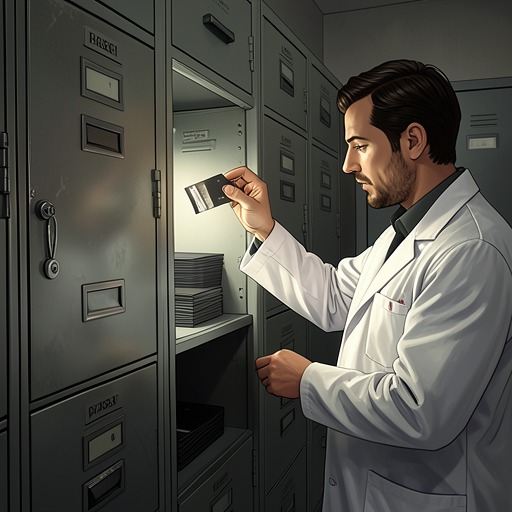
Police Discover Pyxis Retains Complete Medication-Removal Records
The Good Nurse: A True Story of Medicine, Madness, and MurderThe discovery that the Pyxis automated medication dispensing system retained its complete historical data transformed a supposedly lost trail into a recoverable one in the investigation of Charles Cullen. Somerset Medical Center had told detectives that the system kept records for only thirty days; a call to the manufacturer established that it stored every entry from the machine’s installation onward. The recovery gave investigators a detailed account of medication orders and patient charges, but not the simple, conclusive link between a drug and a killer that they needed to prove murder.
Records Believed Lost
The investigation had reached a basic evidentiary impasse. Detectives believed that deadly drugs had been administered to Reverend Florian Gall and another Somerset patient, but they could not directly connect Charles Cullen to those exposures. Unlike a bullet, a drug could not simply be traced from a recovered projectile to a particular weapon and its owner. The Pyxis system seemed to offer a way to trace access to medication, yet investigators had been told that its records disappeared after thirty days. Reverend Florian Gall had been dead nearly four times that long.
The apparent limit had already shaped what the investigators thought they could establish. Danny Baldwin asked to copy records covering the periods around unusual patient events. Mary Lund, Somerset Medical Center’s risk manager, refused, explaining that the system retained records for only thirty days. That answer seemed to close off the most direct electronic record of drug access just when the investigators needed it most. The case appeared stuck not because no record had ever existed, but because the hospital’s account made the relevant record seem irretrievable.
The problem mattered because investigators were trying to distinguish suspicion from an evidentiary chain. Medical consensus pointed to dangerous drugs in patients’ systems, and the investigators had potential victims and a suspect, but they could not show how the drugs had reached the patients. Without the medication-access history, a pattern of deaths and drug abnormalities remained difficult to convert into proof tied to a particular act.
The Manufacturer’s Answer
Tim Braun challenged the thirty-day explanation by looking beyond the hospital. He searched for the company that made the Pyxis system, found Cardinal Health, and called its toll-free number. He introduced himself as a detective sergeant with Homicide and Major Crimes in Somerset, New Jersey, then asked a sales representative whether data roughly six months old could be recovered, comparing the problem to retrieving information after a computer accident.
The representative’s answer overturned the premise of the search: there was no thirty-day window. The system retained every piece of data entered into it from the time it left the factory. Cullen’s activity record, therefore, had not expired; it had remained on the system’s hard drive while the investigation proceeded on the understanding that it was gone. This did not yet establish what the records contained, but it changed the problem from one of impossible recovery to one of obtaining and interpreting the data.
The discovery also exposed a consequential gap between what detectives had been told and what the system could provide. The book does not establish that the manufacturer’s representative independently examined Somerset Medical Center’s machine; rather, the representative corrected the claimed retention limit. That answer gave the investigators a reason to return to the hospital and insist that the complete records be produced.
Obtaining the Complete File
Danny Baldwin went back to Mary Lund’s office with little patience for another incomplete response. The earlier conversations had involved requests and explanations; this encounter was confrontational. He told Lund what he required and when he required it, warning that failure to provide the records could bring federal scrutiny and an obstruction-of-justice charge. Lund then made calls to ask how the data could be retrieved.
Baldwin recorded the process in a police report. It described his meeting with Lund about obtaining Cullen’s Pyxis activity “in its entirety,” noted that detectives had repeatedly been told the system stored data for thirty days, and documented that Lund made inquiries about retrieving the information. The report then stated that the requested data was obtained along with work-assignment sheets for patients in the critical-care units during Cullen’s employment at Somerset Medical Center. The assignment sheets mattered because a medication log alone did not identify the whole clinical context: investigators needed to compare drug activity with which patients were assigned to which staff members.
The resulting Pyxis reports were printed in spreadsheet form. Each time-stamped line recorded Cullen’s trip to the drug computer, the unit and kind of medication ordered, and the patient to whom the charge was assigned. The format turned a hidden electronic history into a document investigators could compare against patient events and work assignments. It offered a way to examine medication activity across Cullen’s time at the hospital rather than relying on the few weeks the supposed retention limit had left visible.
What the Logs Could—and Could Not—Show
The first result concerning Reverend Florian Gall was not the incriminating entry investigators had hoped to find. On the evening before Gall’s overdose, the Pyxis reports showed that Cullen had not withdrawn digoxin during his shift. The shift looked much like the evenings before and after it. Although the investigators had hoped the recovered data would provide a decisive lead, the apparent absence of a digoxin withdrawal did not supply one. The record’s survival solved an access problem; it did not guarantee that the record would directly document the poisoning.
The limitation was central to how the evidence had to be read. The reports showed orders and the patients to whom drugs were billed, not necessarily every route by which a medication could reach a patient. Amy Loughren later recalled that Cullen regularly met pharmacy runners, took their delivery totes, and stocked the unit. What had seemed like helpfulness now suggested that he might obtain drugs without using the Pyxis system at all. That possibility made the recovered logs valuable without making them complete evidence of every drug Cullen could have accessed.
Nor did the reports automatically resolve the meaning of every entry they did contain. Investigators considered whether Cullen’s orders and cancellations might form a pattern, but an unusual transaction could still be explained as a mistake, while a legitimate order could be defended as valid. The Pyxis records and Cerner printouts became the largest body of evidence tying Cullen to drugs associated with Gall’s death, yet they established opportunity and a possible route of access more readily than they proved a particular murder. The discovery therefore marked a decisive investigative reversal, not a finished case: the record was there, but investigators still needed evidence that could connect its entries to the fatal act.